








1:1 vs 2:1 Pulley Ratio: 5 Key Differences
1:1 vs 2:1 Pulley Ratio: 5 Key Differences
Part 1: Introduction
Have you ever walked up to a cable machine at the gym, loaded what you thought was your usual weight, and felt suspiciously heavier---or frustratingly lighter? You're not imagining things.
Here's the scenario: you're building out your home gym, researching functional trainers and lat pulldown machines, and you keep seeing technical specs that read "2:1 pulley ratio" or "1:1 ratio." Manufacturers throw these terms around like everyone should know what they mean. But no one actually explains them---or why you should care.
Here's the pain point: buy the wrong machine, and you could end up with equipment that either feels too heavy for isolation exercises like cable crossovers, or not heavy enough for building a powerful back with lat pulldowns.
This guide cuts through the confusion. You'll learn exactly what 1:1 and 2:1 pulley ratios mean, how they affect your training, and---most importantly---which one is right for YOUR goals. We'll cover definitions, mechanics, a side‑by‑side comparison table, pros and cons, decision guides, and a sample weekly training plan using real RitKeep equipment like the Nimitz N1 and PMAX 5600.
Part 2: What Is a Pulley Ratio? Understanding the Basics
Let's start with a simple definition. A pulley ratio tells you the relationship between the weight you select on the stack and the resistance you actually feel at the handle.
Why does this matter? Pulleys change the mechanical advantage. On a pulley system, 10 lbs doesn't always feel like 10 lbs. The way cables are routed through pulleys changes how hard you need to pull---and that completely changes your workout experience.
Here's the range you'll encounter: 1:1, 2:1, 3:1, and even 4:1 ratios appear on certain machines. As a general rule, higher ratios mean longer cable travel but less resistance at the handle; lower ratios mean true‑to‑weight resistance but shorter cable travel.
The core tradeoff is simple: resistance vs. travel distance. You're either maximizing how much weight you can pull, or maximizing how far and smoothly you can pull it. Understanding this tradeoff is the key to choosing the right equipment.
RitKeep Insight: The Design Logic Behind Home Cable Systems
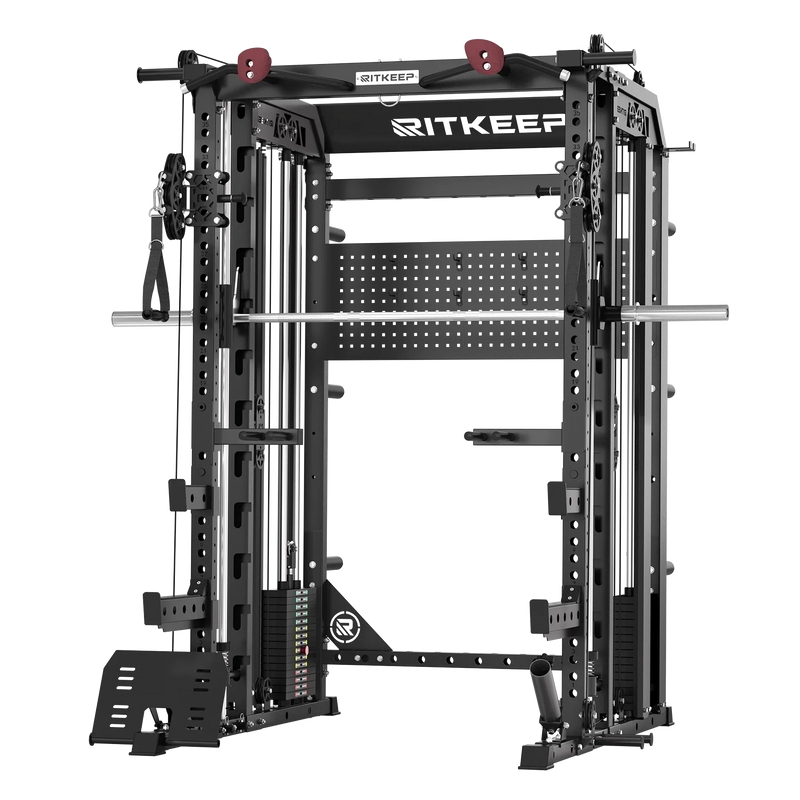
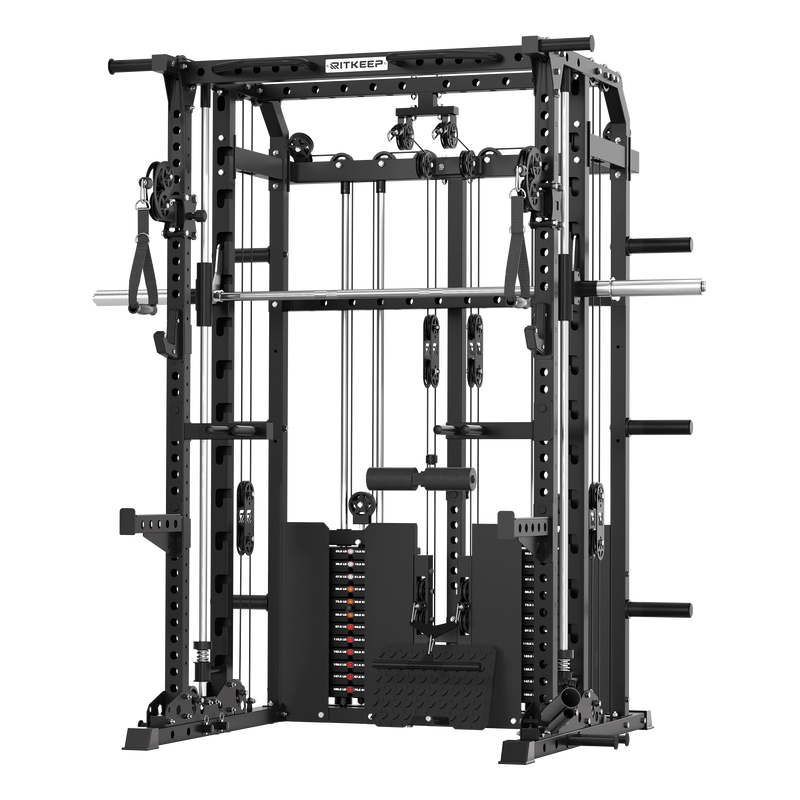
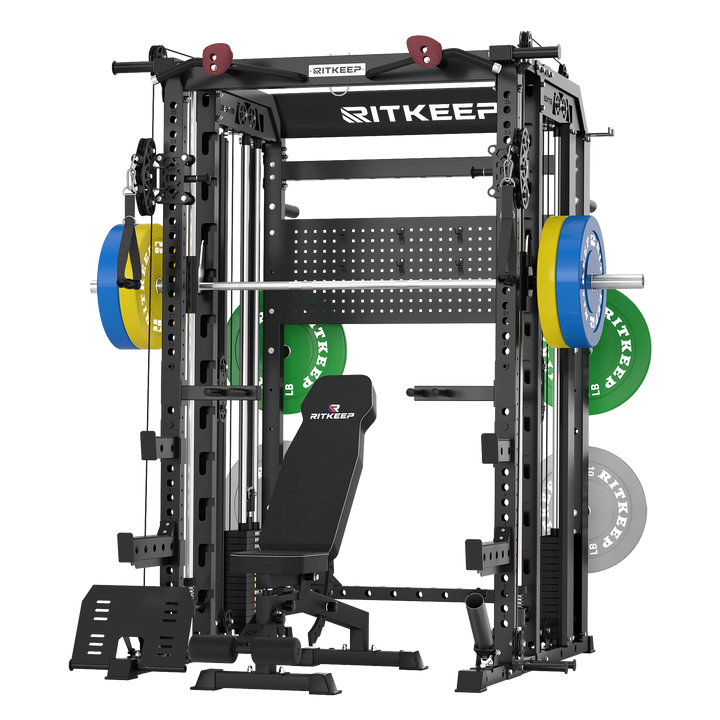
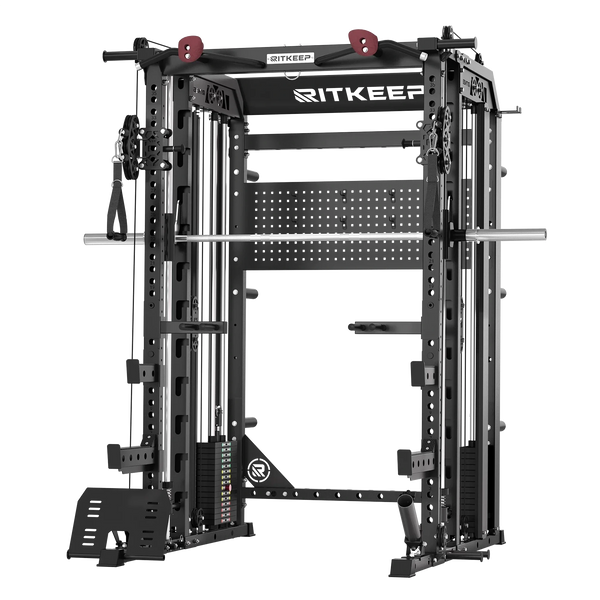
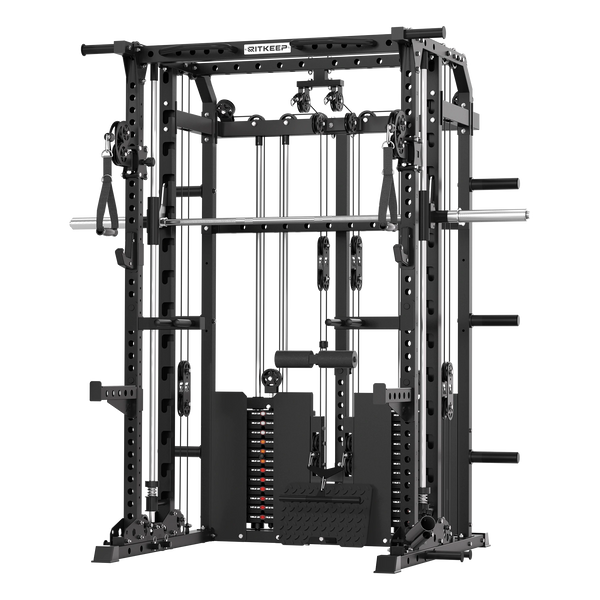
Understanding pulley ratios helps you read equipment specs with confidence. Take the RitKeep Nimitz N1 as an example: it supports both 2:1 and 1:1 switchable pulley ratios. This isn't a "compromise" or cost‑cutting measure---it's a deliberate design choice to meet the multi‑scenario training needs of different family members:
- 2:1 mode --- effective resistance is halved, cable travel is longer, and movement is smoother. Perfect for teenagers, women, seniors, or anyone doing warm‑ups, rehab work, and high‑rep isolation exercises.
- 1:1 mode --- true resistance output, ideal for heavy training, rows, and lat pulldowns when you need to push real weight.
One machine, two ratios, usable by the whole family. That's not a compromise---that's mature, thoughtful design for the modern home gym.
Part 3: What Is a 1:1 Pulley Ratio?
A 1:1 pulley ratio means the weight you select on the stack is exactly the resistance you feel. Select 100 lbs, and you're pulling 100 lbs of resistance---no math required, no hidden surprises.
Formula: Effective Resistance = Selected Weight × 1
Example: Select 100 lbs → you feel 100 lbs
The mechanics are straightforward. This is often called a "single‑pulley" machine. The cable attaches to your handle, routes through one pulley, and connects directly to the weight stack. For every foot you pull the handle, the weight stack moves the same distance upward. There's no mechanical advantage (or disadvantage) being introduced.
So, what is a 1:1 pulley ratio best for? Heavy lat pulldowns, seated rows, and compound pulling movements where raw strength is the priority. If your goal is to progressively overload your back with maximum resistance, this is your ratio.
Pros of 1:1 pulley ratio:
- True‑to‑weight resistance---no mental math, no guesswork
- Maximum weight availability for heavy lifts
- Ideal for progressive overload on lat pulldowns and rows
- No "conversion" when transitioning between different machines
Cons of 1:1 pulley ratio:
- Shorter cable travel, which can limit range of motion on exercises like crossovers and flyes
- Larger weight increments can make small progressions difficult for isolation work
- Less smooth cable motion compared to 2:1 systems
- May feel "jerky" during high‑rep accessory exercises
Part 4: What Is a 2:1 Pulley Ratio?
A 2:1 pulley ratio cuts the resistance in half. Select 100 lbs on the stack, and you're actually pulling 50 lbs of resistance at the handle. This can be confusing at first---but once you understand why, it makes perfect sense.
Formula: Effective Resistance = Selected Weight × 0.5
Example: Select 100 lbs → you feel 50 lbs
The mechanics: this is a "double‑pulley" system. For every foot you pull the handle, the weight stack moves two feet upward. That additional pulley reduces inertia and gives you a faster‑moving, smoother cable glide. The tradeoff? Reduced resistance at the handle.
What is a 2:1 pulley ratio best for? Functional training, explosive movements, high‑rep accessory work, and exercises where smoothness matters more than maximum load---cable crossovers, chest flyes, face pulls, triceps pushdowns, and rotational core work. Commercial gyms almost universally use 2:1 ratios on their cable crossovers for this exact reason: the fluid motion and extended range of motion make isolation exercises feel effortless.
Another critical benefit: effective weight increments are smaller. On a 1:1 machine, adding the smallest weight pin might jump 10 lbs, which is too much for small muscle groups like rear delts. On a 2:1 machine, that same pin only adds 5 lbs of actual resistance, allowing much finer progression.
Pros of 2:1 pulley ratio:
- Smoother, faster cable motion
- Longer cable travel---typically double the length of a 1:1 system
- Smaller effective weight increments (easier progression for small muscles)
- Ideal for functional and isolation exercises
- More forgiving on joints during high‑volume work
Cons of 2:1 pulley ratio:
- Resistance is halved---requires mental math to know what you're actually moving
- May not provide enough resistance for heavy lat pulldowns or rows (depends on stack size)
- Requires larger weight stacks to deliver adequate resistance
- Heavier total machine weight and typically higher cost for dual‑stack configurations
The Complete Solution for 2:1 Systems
The core challenge of a 2:1 pulley ratio is simple: effective resistance is cut in half. RitKeep solves this problem in two smart ways:
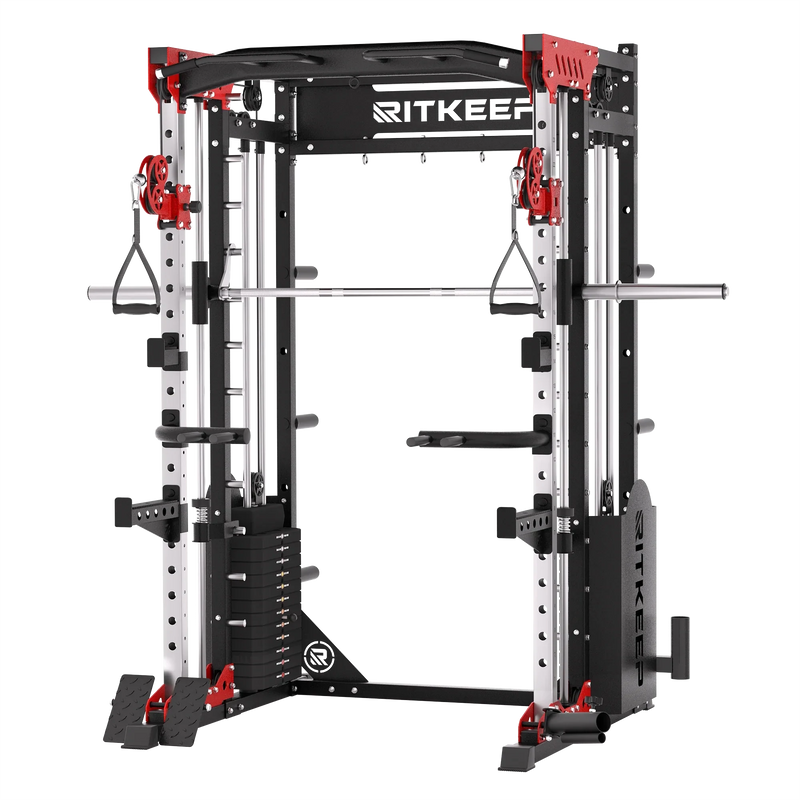
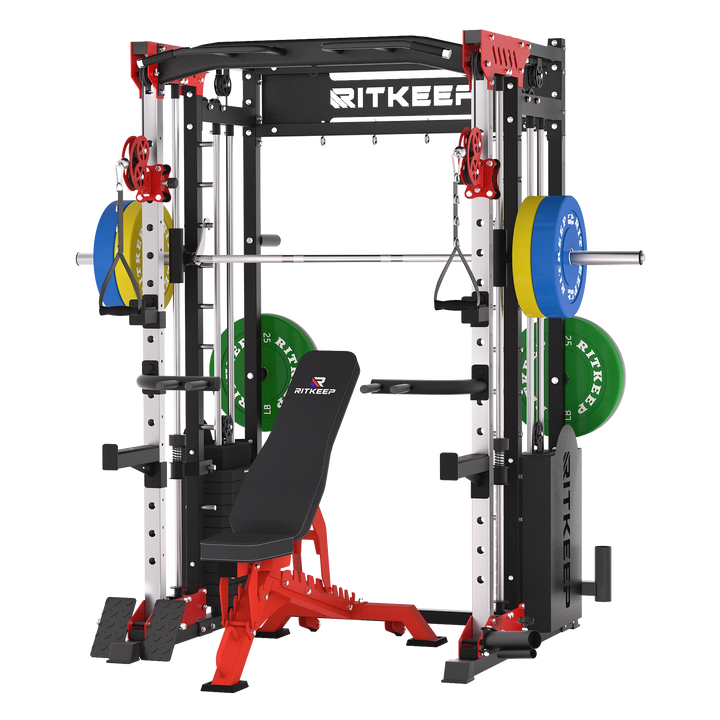
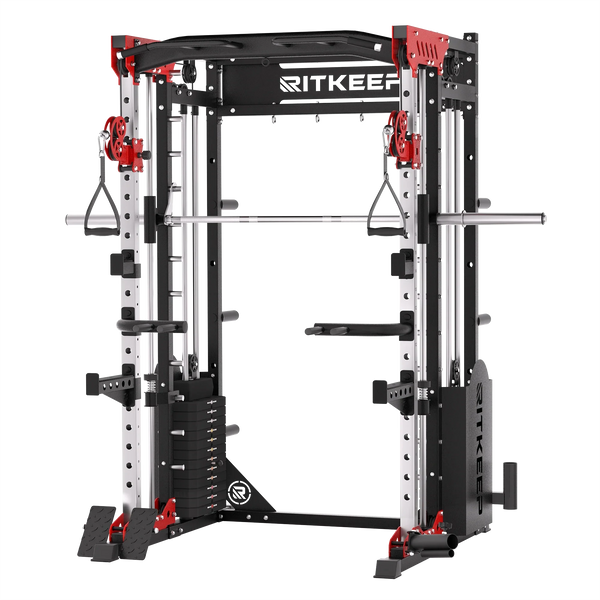
Large weight stacks --- The PMAX 5600 features dual 160 lb weight stacks per side (320 lbs total), with an optional upgrade to 400 lb stacks. This ensures you never run out of training capacity.
Add‑on weight pegs (Pro version) --- The Nimitz N1 Pro adds plate‑loading pegs on top of the weight stacks, allowing up to 100 kg of additional resistance, pushing total effective resistance past 200 kg. This means you get the smooth 2:1 experience without ever facing a "not enough weight" bottleneck.
These solutions are notably rare in home gym equipment at this price point. You get the best of both worlds: fluid 2:1 motion with commercial‑grade resistance capacity.
Part 5: Quick Comparison Table
| Comparison Aspect | 1:1 Pulley Ratio | 2:1 Pulley Ratio |
|---|---|---|
| Effective Resistance Formula | Selected Weight × 1 | Selected Weight × 0.5 |
| Example (100 lbs selected) | Feels like 100 lbs | Feels like 50 lbs |
| Resistance Feel | Exact weight selected | Half the weight selected |
| Cable Travel | 1 ft pull moves the stack 1 ft | 2 ft pull moves stack 1 ft |
| Best Exercises | Heavy lat pulldowns, seated rows, compound pulls | Cable crossovers, chest flyes, face pulls, triceps pushdowns, wood chops, lateral raises |
| Smoothness | Less smooth — can feel "jerky" on isolation work | Smoother, faster‑gliding cable action |
| Weight Progression | Larger jumps (10 lbs feels like 10 lbs) | Smaller effective jumps (10 lbs feels like 5 lbs) |
| Ideal User | Strength‑focused lifters who need heavy pulling resistance | Functional training enthusiasts, rehab patients, and those prioritizing range of motion |
| Typical Machine Type | Single‑stack lat pulldown machines, dedicated row stations | Dual‑stack functional trainers, cable crossover machines |
| Footprint | Generally more compact | Usually larger (dual stacks) |
| Example Models | Dedicated lat pulldown stations | REP Arcadia, Rogue CC‑1, RitKeep PMAX 5600, RitKeep Nimitz N1 |
Part 6: The Third Option -- Switching Between 1:1 and 2:1
Here's where things get interesting. Some modern cable systems allow you to switch between 1:1 and 2:1 ratios on the same machine in seconds.
The use case is compelling: warm up with 2:1 for lighter, faster movements to activate the muscles and practice form. Then, when you're ready for heavy working sets, switch to 1:1 to push real weight without any resistance reduction.
The efficiency benefit is clear: you save space and money---one machine does both jobs. Instead of buying a dedicated lat pulldown station (1:1) AND a separate functional trainer (2:1), you get both functions in a single footprint.
RitKeep Innovation
The RitKeep Nimitz N1 supports manual switching between 1:1 and 2:1 pulley ratios through a simple bypass routing configuration:
- 2:1 mode --- Standard cable routing path. Longer travel, higher smoothness. Perfect for warm‑ups, flyes, and high‑rep accessory work.
- 1:1 mode --- Bypasses the moving pulley for direct force transmission. Great for heavy rows, lat pulldowns, and progressive overload on back day.
The value of this design is simple: one machine covering two training logics. You never have to choose between "smoothness" and "weight capacity." You never have to buy two separate machines. From space efficiency to return on investment, this is currently one of the smarter solutions in the home cable system market.
Part 7: Which Pulley Ratio Should You Choose? 3 Decision Guides
Guide 1 -- For the Heavy Lifter (Choose 1:1)
If your priority is heavy lat pulldowns, seated rows, and maximizing strength on pulling movements, you need the full weight stack without any "halving." If you're already pulling over 100 kg on lat pulldowns, a 2:1 system will likely limit your progress.
What to look for: RitKeep N1 switched to 1:1 mode, or consider RitKeep's commercial‑grade options. Effective resistance equals stack weight---no conversion math required.
Guide 2 -- For Functional Training Enthusiasts / Home Gym Owners (Choose 2:1)
If you want a do‑it‑all cable system for crossovers, flyes, rows, pushdowns, and rotational work, choose 2:1. Most home functional trainers use a 2:1 ratio for a reason---it's the smooth, versatile choice that works for everyone in the household.
Reality check: 90% of gym‑goers will never max out a 2:1 machine, and 99.9% wouldn't max out a 1:1. For most home users, effective weight isn't the limiting factor---range of motion and exercise variety are.
What to look for: RitKeep PMAX 5600 or N1 (in 2:1 mode) are mature choices. The longer cable travel and smoother starting feel work perfectly for flyes, face pulls, and rotational training.
Buying Guide
Heavy lifters (choose 1:1)
Focus on RitKeep N1 switched to 1:1 mode, or consider RitKeep's commercial series. Effective resistance equals stack weight with no conversion loss.
Home fitness / functional training (choose 2:1)
RitKeep PMAX 5600 or N1 (in 2:1 mode) are strong choices. The longer cable travel and smoother starting feel work perfectly for flyes, face pulls, and rotational training.
Hypertrophy‑focused lifters (consider dual‑ratio machines)
RitKeep N1 is the most fitting choice for this use case. Hypertrophy training demands both heavy compound movements (use 1:1) AND high‑rep isolation work (use 2:1). A single machine that switches ratios eliminates the need to compromise---or to buy two separate machines.
Part 8: Sample Weekly Training Plan
Here's a balanced training week assuming you have a machine that supports both 1:1 and 2:1 mode switching (like the RitKeep Nimitz N1).
Day 1 -- Back Strength (1:1 mode)
- Wide‑grip lat pulldown --- 4 × 8 reps
- Seated cable row --- 4 × 10 reps
- Straight‑arm pulldown --- 3 × 12 reps
Day 2 -- Chest & Shoulders (2:1 mode)
- Cable crossover --- 3 × 15 reps
- Low‑to‑high cable fly --- 3 × 15 reps
- Face pull --- 3 × 20 reps
- Lateral raise (cable) --- 3 × 15 reps
Day 3 -- Arms & Core (2:1 mode)
- Triceps pushdown --- 3 × 12 reps
- Cable curl --- 3 × 12 reps
- Wood chop (obliques) --- 3 × 15 reps per side
Progression Strategy
Track your weight and reps each session. Aim to add either 2.5‑5 lbs or one extra rep each week.
- Example progression (lat pulldown): Week 1 → 100 lbs × 8 reps. Week 2 → 105 lbs × 8 reps (add weight). Or Week 2 → 100 lbs × 9 reps (add rep first, then weight later).
- Small jumps matter: On 2:1 machines, adding a 10 lb plate on the stack only adds 5 lbs of effective resistance---perfect for slow, steady progress on smaller muscle groups.
Progressive overload---not which machine you own---is what drives long‑term results.
RitKeep Note
The training plan above assumes a machine that supports both 1:1 and 2:1 switching, such as the RitKeep Nimitz N1. If your equipment has a fixed pulley ratio, keep these adjustments in mind:
Fixed 1:1 machines: Flyes, face pulls, and similar exercises may have limited cable travel. Consider using longer attachments or shortening the movement range to stay within the cable's length.
Fixed 2:1 machines: Back day requires selecting larger weight stack numbers (target weight × 2). For example, if you want to pull 50 kg of resistance, you'll need to select 100 kg on the stack.
If you're using a RitKeep dual‑ratio machine, simply follow the mode switching shown above---no extra calculations needed.
Part 9: Frequently Asked Questions
Q: Which pulley ratio is better for lat pulldowns?
A: 1:1 is generally better. You get full weight stack access for heavy pulling without any resistance reduction. A 2:1 machine may not provide enough effective resistance for advanced lifters, though larger stack options can help compensate.
Q: Why do commercial gyms use 2:1 on their cable crossovers?
A: Smoothness and range of motion. Most users don't need the full weight stack for flyes and isolation work---they need fluid motion and long cable travel. That's why nearly every commercial cable crossover uses a 2:1 ratio.
Q: Does pulley ratio matter for beginners?
A: Yes---and 2:1 is often more beginner‑friendly. The smaller effective weight increments make progression feel less intimidating, and the longer cable travel accommodates learning proper form across a full range of motion. But beginners should still learn fundamental movement patterns---hip hinge, squat depth, bracing---rather than relying solely on the machine.
Q: Is a 2:1 machine "weaker" than a 1:1 machine?
A: No, it's just different. A 2:1 machine typically has a larger weight stack to compensate. For example, the RitKeep PMAX 5600 offers dual 160 lb stacks (upgradeable to 400 lbs). The key difference is feel and travel distance---not quality or capability.
Q: What do 1:1 and 2:1 mean on a lat pulldown machine?
A: On a 1:1 lat pulldown machine, 100 lbs selected on the stack feels exactly like 100 lbs of resistance. On a 2:1 machine, 100 lbs selected feels like 50 lbs---which is why a 2:1 lat pulldown requires a much larger weight stack to provide adequate resistance for heavy pulling.
Part 10: Final Takeaway -- Making Your Decision
Let's recap the core tradeoff.
1:1 pulley ratio gives you true resistance and maximum available weight. No conversion math, no guesswork. Perfect for heavy lat pulldowns, rows, and progressive overload on back day.
2:1 pulley ratio gives you smoother travel, longer range of motion, and lighter effective weight increments. Perfect for cable crossovers, flyes, face pulls, and high‑rep accessory work.
Neither ratio is objectively "better." One is better for YOUR specific goals.
If you can afford a dual‑ratio system like the RitKeep Nimitz N1, that's the ultimate home gym solution. You get the best of both worlds without compromise---one footprint, two training logics, zero tradeoffs.
If budget or space requires choosing one:
- Prioritize 1:1 if heavy lifting is your primary focus (lat pulldowns, rows, strength work)
- Prioritize 2:1 if you want a versatile functional trainer for isolation work and accessory training (flyes, crossovers, face pulls, pushdowns)
Buying checklist:
- Know your training goals before you look at any price tag
- Check effective resistance vs. stack weight---don't be misled by raw numbers
- Verify the cable travel length works for your height and preferred exercises
- Test smoothness before buying if possible---run the cables through full range
Action step: Now that you understand the difference between 1:1 and 2:1 pulley ratios, you can confidently read product specs, ask the right questions, and purchase the machine that fits YOUR training style.